
Car passage and footfall data pack
What are car passage and footfall?
Car passage and footfall describe how many people pass through or near a location.
They can be used in two ways in the platform:
- Traffic and pedestrian volumes on a road segment or building
- Relevant car passage or footfall for a specific location
These two concepts are related, but they are not the same.
1. Traffic and pedestrian volumes
Traffic volumes and pedestrian volumes show the total number of vehicles or pedestrians passing through a specific area.
- Traffic volume , also called car passage, refers to the number of vehicles.
- Pedestrian volume, also called footfall, refers to the number of people walking.
- Volumes are generally expressed as a weekly volume.
- Traffic volumes are available on road segment level.
- Pedestrian volumes are available on road segment level and can also be displayed on building level.
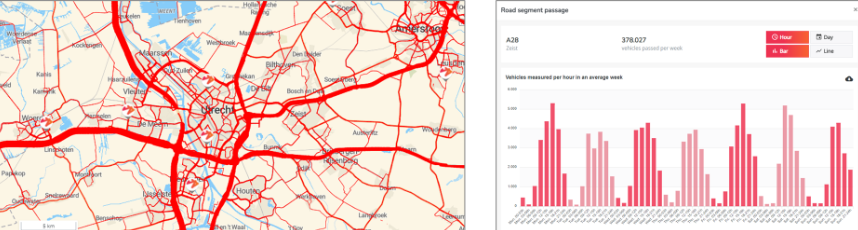
Car passage in the platform
Car passage can be viewed in two ways:
- As a map layer, showing traffic volumes across the road network.
- As a graph for a specific road segment.
The graph gives a more detailed view of the car passage on a speicifc road segment. It shows the traffic volume by weekday and can also show traffic by hour.
This helps users understand not only how much traffic passes a road segment, but also when that traffic is most relevant for a store or location.
Footfall in the platform
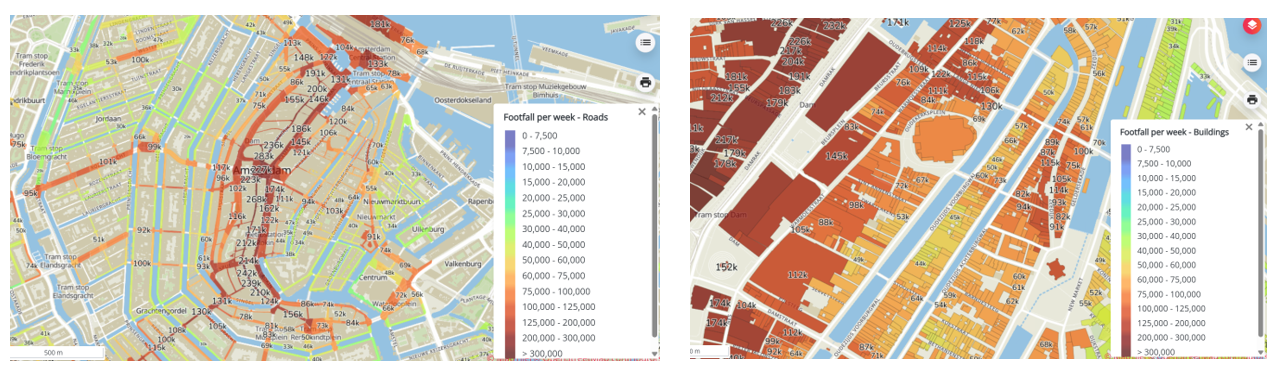
Footfall is shown as a map layer and can be displayed both on road segment or on building level.
Footfall values represent weekly pedestrian volumes. They help users understand how busy pedestrian areas are and how much pedestrian activity exists around streets, buildings, or locations.
Footfall on building level
Footfall can also be shown for individual buildings. This gives users a more detailed view of pedestrian activity around specific buildings or premises.
Building-level footfall is derived from nearby pedestrian volumes. The platform translates footfall from road segments and surrounding street areas to buildings by looking at which pedestrian flows are spatially connected to each building.
For most buildings, the platform uses a weighted average of nearby pedestrian volumes. For corner buildings, where multiple pedestrian flows may be relevant, the platform takes into account the strongest nearby pedestrian flow. The final building-level value is selected to best represent the pedestrian exposure of that building.
This means building-level footfall should be interpreted as an estimate of the pedestrian activity and visibility around a building, rather than a direct count inside the building.
2. Relevant car passage and footfall for a location
Relevant car passage and relevant footfall are location characteristics.
They estimate how visible and accessible a location is to people passing nearby by car or on foot.
For each location, the platform identifies the road segments that are visible and accessible from that location. These visible and accessible road segments are considered relevant because people passing there can realistically see or pass the location. The relevant passage value is then calculated based on the volumes of those selected road segments.
This selection of relevant road segments is called the passage configuration of a location. When a location is added or uploaded to the platform, the passage configuration is created automatically.
Difference between volume and relevant passage
| Concept | What it measures | Level | Where it is shown | Example use |
|---|---|---|---|---|
Car passage / traffic volume | Number of vehicles passing a road segment | Road segment | Map layer (weekly volumes) and graph (hour/day volumes) | Understanding traffic volume by road segment, weekday, or store opening hours |
Footfall / pedestrian volume | Number of pedestrians in an area | Road segment or building | Map layer (weekly volumes) | Understanding weekly pedestrian activity in an area or around a building |
Relevant car passage or footfall | Estimated relevant passing volume for a specific location, based on visible and relevant road segments | Location | Location characteristics (weekly volumes) | Understanding the visibility or exposure of a site to the nearby traffic or footfall |
Data coverage
The car passage and footfall data covers a 12-month period.
Availability in the platform
The car passage and footfall data is not included by default in every platform configuration.
It is available as an additional data pack and can be implemented upon request.
For more information about this data pack, please contact support@retailsonar.com.